
Bill 44 has changed what “normal” residential lots can support across B.C., and Nanaimo’s response is what you feel on the ground: many neighbourhood lots that used to be limited to one home or a duplex now fall under R5 (Three and Four Unit Residential) rules, which can make three units possible more often, and four units possible on some larger lots. If you’re trying to turn “allowed” into “buildable,” the fastest next step is a quick feasibility review with a custom home builder Nanaimo who can flag the common constraints before you spend on full design.
This page breaks down what changed, what R5 can realistically allow, and the practical checks that matter in Nanaimo, including servicing, site constraints, and permits. For the official Nanaimo-specific summary, the City’s R5 Zone Guide is the most useful starting point for homeowners.
Most people want one clear answer: “How many units can I build now?” In Nanaimo, the honest answer is: R5 expands what’s permitted, but your lot specifics still decide what’s feasible and approvable.
- R5 commonly supports up to 3 dwelling units on lots that meet R5 zoning.
- More 4-unit options apply on lots that are 280 m² (3,014 ft²) or larger.
- R5 does not remove the need for permits, and it does not override title restrictions or site constraints.
- If you design around servicing, access, parking, and siting early, you reduce redesign cycles and permit friction.
What Is Bill 44 In Plain Language?
Bill 44 is B.C.’s Housing Statutes (Residential Development) Amendment Act, 2023. In practical terms, it changed parts of provincial law that shape what local governments can and must allow through planning and zoning, including requirements tied to small-scale multi-unit housing in areas that were historically limited to one home or a duplex.
For homeowners, you do not need to read the entire act to feel its effects. The big takeaway is that municipalities have had to update zoning frameworks so more gentle density is permitted in more places, and Nanaimo’s R5 rules are a clear example of that shift.
Why Homeowners Feel It As A “Zoning Change”
Before Bill 44-style reforms, adding density often meant a longer path that could include rezoning, more public process, and higher uncertainty. The newer approach pushes more of the “missing middle” conversation into the baseline zoning rules, so your first question becomes, “What does my zoning already permit?”
In Nanaimo, that’s why you hear R5 mentioned so often. It is a zoning response that makes three and sometimes four units possible without starting from scratch every time, provided your site can meet the requirements.
One Process Change Worth Knowing
One notable change in Bill 44 is how it can limit when a local government can hold a public hearing for certain zoning bylaws, including when the purpose is to comply with small-scale multi-family housing requirements. That does not eliminate local review, but it can change the “shape” of the process compared to how rezonings used to work.
Bottom line: in many cases, the work shifts from “Can I rezone?” to “Can I design a compliant, buildable project that meets the rules and the site realities?”
What Changed In Nanaimo, Specifically?
The City’s Response And The Key Date
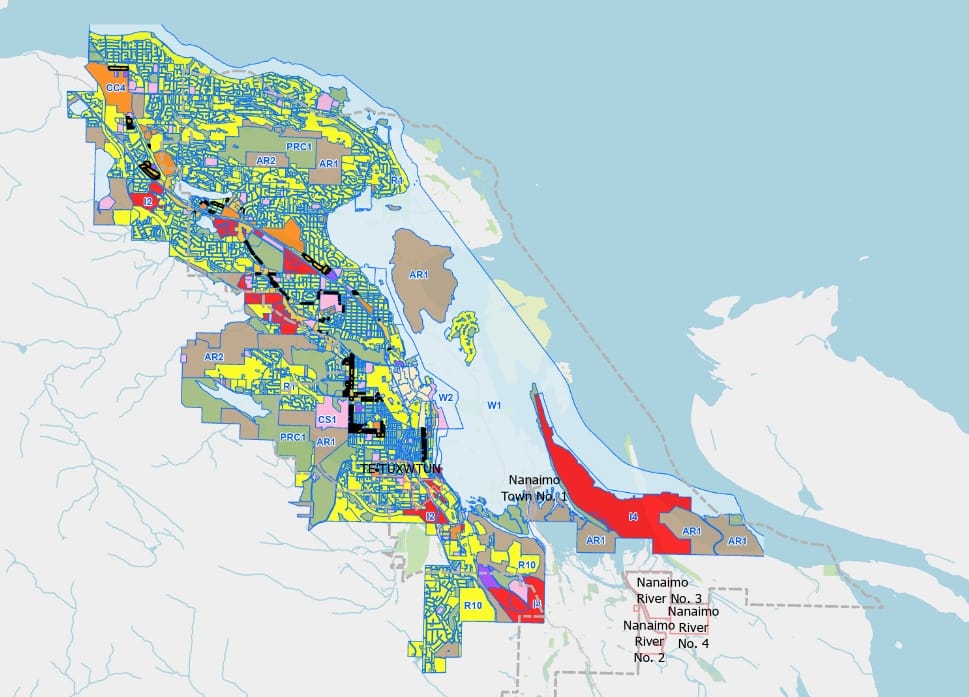
Nanaimo’s zoning updates tied to small-scale multi-unit housing were adopted in mid-June 2024, and the City’s R5 guidance is written for property owners who are trying to understand what that means on a typical residential lot. The key point is not just that the rules changed, but that the City created a clearer framework for three- and four-unit outcomes in many neighbourhood contexts.
If you’re comparing your memory of “single-family zoning” to today’s reality, that’s why the shift feels big. Your baseline zoning may now permit more forms than it did prior to June 2024, even if the street still looks mostly the same.
R5 Is Now A “Common Default” But Not Universal
In Nanaimo, R5 is widespread, but it is not everywhere. There are multiple residential zones, and each has its own density and siting rules. If your lot is not zoned R5, it does not automatically mean “no,” but it does mean you need a different starting point for what’s permitted.
This is why your first action should be confirmation, not assumptions. A lot that is slightly smaller, oddly shaped, or located within special areas (like environmental or hazard overlays) can behave very differently than the lot next door.
The Best Nanaimo-Specific Reference To Keep Handy
If you only keep one document open while you’re thinking about R5, make it the City’s Three and Four Unit Residential (R5) Zone Guide. It is written for property owners, and it highlights the exact categories of issues that tend to derail projects: zoning, development permit areas, title restrictions, site servicing capacity, parking requirements, and building code triggers.
It also does something important: it makes space for reality. The guide is clear that even if zoning permits a maximum density, it may not be physically feasible or financially viable on every property.
What R5 Zoning Can Allow On Your Lot
3 Units Vs 4 Units (This Is Where People Get Tripped Up)
In Nanaimo’s R5 framework, three units are broadly supported, and more four-unit options apply on lots that are 280 m² (3,014 ft²) or larger. That size threshold is one of the fastest “first-pass” checks you can do before you get too attached to a fourplex concept.
Even if your lot clears that threshold, you still need to meet the siting rules that actually shape the building: setbacks, lot coverage, height, and access. Nanaimo’s guidance also notes that (as of June 17, 2024) there is no maximum floor area ratio (FAR) in the R5 zone, so what you can build is determined by the form rules rather than a single FAR cap.
Common R5 Building Forms
When people say “R5 allows four units,” they’re often thinking only of a fourplex. In practice, R5 supports a range of building forms, and the right answer depends on your goals and your lot:
- A house
- A house with a secondary suite
- A house with a detached suite (carriage house)
- A house with a secondary suite and a detached suite (often with added requirements)
- A detached duplex (two principal dwellings)
- A triplex (three units in one building)
- On eligible lots, a fourplex (four units in one building)
The key is matching the form to what your site can support for parking, servicing, and access, not just what looks good on paper.
Two-Principal-Building Limit (Important Constraint)
One of the most overlooked R5 constraints is that multi-family residential use in the R5 zone is limited to a maximum of two principal buildings on a lot. That matters because some “four unit” concepts people imagine actually rely on spreading units across more than two principal buildings.
Nanaimo’s R5 guidance also notes that a variance to waive that requirement may be considered on a case-by-case basis through a form and character development permit process. The main point for you is simple: if your concept relies on more than two principal buildings, treat that as a higher-complexity path until proven otherwise.
A Quick Breakdown
Use this as a practical way to sort ideas before you start sketching floor plans. It’s not a substitute for the zoning bylaw, but it’s a helpful “start here” filter.
| Target Density | Typical Configuration | Lot Size Trigger | Common Constraint Notes |
| 3 units | House + suite + detached suite | Works on many R5 lots | Servicing capacity, parking, and siting drive feasibility; some forms can trigger fire suppression requirements |
| 3 units | Triplex (one building) | Works on many R5 lots | Building code complexity can increase; siting, access, and parking must be solved early |
| 3 units | House + duplex (two buildings) | Works on many R5 lots | Two principal buildings max fits, but site layout needs care |
| 4 units | Fourplex (one building) | More options on lots ≥ 280 m² | Parking and access often become the limiting factor; building requirements may increase |
| 4 units | Two duplexes (two buildings) | More options on lots ≥ 280 m² | Still limited to two principal buildings; servicing upgrades can be significant |
R5 Does Not Mean “Automatic.” Do These Feasibility Checks First.
Step 1: Confirm Zoning And Overlays
Start by confirming your zoning and then checking whether your lot sits within any special areas that add guidelines or restrictions. In Nanaimo, development permit areas can include environmental sensitivity, hazardous slopes, sea level rise, wildfire hazards, and other overlays that can change what is reasonable to build.
If your lot is affected by one of these overlays, the project is not necessarily a non-starter. It just means you need to treat design as a site-specific problem, not a template you copy from another street.
Step 2: Check Title Restrictions
Zoning is only one layer. Your property title may include restrictive covenants, building schemes, easements, or rights-of-way that affect siting, access, or even what forms are permitted. Some of these restrictions are private, and the City may not be aware of all of them.
Practically, this is why “my neighbour did it” is not proof that your lot can do the same thing. Your title package is part of your feasibility checklist, not an afterthought.
Step 3: Look Hard At Site Servicing Capacity
Servicing is one of the biggest reality checks when moving from one or two units to three or four. Many older neighbourhood lots were originally serviced for lower density, and increasing units can require upgrades to water, sanitary, stormwater, and sometimes fire flow capability at or near the property.
If you want a plain-language way to review what to ask and what to look for, use our site servicing checklist before you spend heavily on drawings. It helps you identify the “hidden scope” items that can affect cost and timeline.
Step 4: Assess Physical Site Constraints Early
Nanaimo has variable topography, and physical features can quickly limit what’s feasible: steep slopes, rocky outcrops, floodplains, waterbodies, and irregular lot geometry. Even when zoning permits a higher unit count, the site may not physically support it without design compromises or variance requests.
If your lot has slope or soil concerns, do not wait until late-stage design to find out you need additional engineering. Here’s our guide to when a geotechnical report in Nanaimo is commonly needed and why it matters for planning.
Step 5: Parking And Access Reality Check
Parking requirements still exist, and access must work safely and practically. On many R5 concepts, parking layout is what forces the plan to change, not setbacks. That’s especially true on narrower lots or lots where access is constrained by grade, existing structures, or a lack of lane access.
A good rule is to treat parking and access as part of concept design, not a “permit drawing detail.” If you cannot make vehicles and pedestrians work cleanly, the rest of the design will keep getting pulled apart.
Step 6: Decide Your End Game (Rental, Multi-Gen, Sale, Strata)
R5 can support very different outcomes: a mortgage-helper suite, multi-generational living, or a small multi-unit build intended for long-term rental or sale. Your “end game” changes how you should design unit sizes, entries, outdoor space, acoustics, storage, and durability.
It also affects your risk tolerance. A three-unit project designed for family flexibility may prioritize privacy and simple construction, while a four-unit concept designed as an infill build may accept higher complexity to maximize rentable area. The earlier you decide the goal, the fewer redesign cycles you’ll face.
Permits And Approvals In Nanaimo: What Got Easier, What Did Not

What R5 Can Reduce: Rezoning Requests For Small-Scale Forms
The main “ease” created by Bill 44-era changes is that more housing forms can be permitted through baseline zoning, which can reduce how often you need to start with rezoning for gentle density. That’s a meaningful shift for homeowners because it can remove a major uncertainty from the early feasibility stage.
However, reduced rezoning does not mean reduced planning. It just shifts your focus to compliance, feasibility, and a clean permit strategy that fits your property.
What You Still Need: Building Permits, And Sometimes Development Permits
If you’re building three or four dwelling units, Nanaimo has a specific permit pathway that applies to new builds and to projects that increase a lot to three or four total units (including suites). It’s a key page to review once your concept is taking shape.
You should also expect that the City will want a higher level of plan quality on projects over two units. Nanaimo’s R5 guidance notes that plans for more than two dwelling units must be prepared by a qualified building designer or architect, and they must show both municipal requirements and BC Building Code information.
Where Development Permits Can Show Up
Development permits are not “always required,” but they can apply depending on where you are and what you’re proposing. They also come into play when you’re asking for variances or when your lot sits in a development permit area with additional guidelines.
If you want the Nanaimo-specific breakdown of what triggers a development permit and how timelines typically work, we go deeper here: development permits for homes in Nanaimo.
Where To Start If You’re Brand-New To The Nanaimo Permit Sequence
If you’re new to building in Nanaimo, start by learning the permit sequence at a high level so you don’t confuse zoning permission with permit approval. Once you understand the order of operations, it becomes much easier to plan design, budgeting, and decision points.
Here’s our overview of City of Nanaimo permits for custom homes, written to help you understand what happens when and why.
Design Considerations That Matter Specifically For R5 Projects

Site Layout And “Neighbour-Fit”
R5 projects succeed when they feel like they belong on the street. That usually comes down to site layout details: how entries face the street, where windows look, how outdoor space is buffered, and how garbage and storage are handled without turning the lot into a maze.
If your goal is three or four units, take privacy and circulation seriously. Separate entries, clear paths, and good sightlines reduce neighbour friction and make the homes easier to live in and manage long-term.
Fire And Building Code Complexity Can Increase With Certain Forms
As density and building form change, building code requirements can change too. Some R5 building forms may trigger additional requirements such as fire suppression systems, which can affect cost, mechanical design, and coordination.
This is why “max units” is not always the smartest first goal. A well-designed three-unit plan that is straightforward to permit and build can sometimes outperform a higher-complexity four-unit plan when you measure risk, time, and total project friction.
Parking And Access Should Be Drawn Early, Not At Permit Time
Parking, turning movements, and access grades are not details you want to solve at the end. They shape the building footprint, they influence entry locations, and they affect how livable each unit feels.
When we review early concepts, we like to see access and parking shown from day one. It keeps the project honest and reduces the chance of costly redesign late in the process.
Cost And Schedule Implications When You Move From 1 Home To 3–4 Units

What Tends To Add Cost
Three- and four-unit concepts usually add cost through complexity, not just square footage. You’re coordinating more kitchens and baths, more life safety considerations, and often more servicing work. On some lots, utility upgrades become a major cost driver.
Design also tends to be more intensive. A compliant multi-unit plan needs more attention to layout, siting, acoustic separation, mechanical planning, and fire and egress details than a typical single home.
What Tends To Add Time
Even when zoning is favourable, time expands when you increase unit count. Your drawings typically require more detail, the review process can be more involved, and your trades coordination becomes more complex.
A lot of time is also lost to late-stage surprises, like finding out servicing upgrades are required or learning a development permit overlay applies. The earlier you identify those constraints, the more predictable your schedule becomes.
A Practical Planning Approach (Without Overpromising)
A practical way to plan an R5 project is to treat it as stages:
- Quick feasibility check (zoning, title, servicing, physical constraints)
- Concept site plan (parking, access, massing, basic unit mix)
- Early City questions (confirm any triggers and required submissions)
- Permit-ready drawings and coordination
This approach is less exciting than jumping straight to floor plans, but it’s how you reduce risk and keep momentum.
Who R5 Helps Most In Nanaimo
Homeowners Adding “Mortgage Helper” Density
For many homeowners, R5 makes it easier to consider a suite or a detached suite as part of a long-term plan. The benefit is flexibility: you can create income potential, housing for family, or a future downsizing option without leaving your neighbourhood.
The best “mortgage helper” designs feel like homes, not afterthoughts. Separate entries, good sound control, and usable outdoor space matter as much as unit count.
Multi-Generational Living
R5 can also support multi-generational living where people want closeness with independence. That often means separate kitchens, separate entrances, and clear boundaries so the setup works for years, not just months.
If this is your goal, prioritize accessibility, privacy, and simple circulation. The most functional multi-gen layouts are usually the ones with the least friction in daily life.
Small Infill Builders Focused On Gentle Density
For small infill builders, R5 creates opportunities for well-designed triplexes and fourplexes that fit neighbourhood scale. The best projects are the ones that respect site realities and keep design and construction clean.
Infill success in Nanaimo often comes down to fundamentals: servicing capacity, parking solutions that don’t dominate the lot, and building forms that keep massing reasonable.
Common Mistakes To Avoid With Nanaimo R5
R5 has made more projects possible, but the same mistakes still derail plans. Here are the ones we see most often when people start exploring three- and four-unit concepts.
- Assuming R5 means four units everywhere. In Nanaimo, more four-unit options generally apply once a lot is 280 m² (3,014 ft²) or larger, and even then, design still has to comply with siting and permit requirements.
- Designing before confirming servicing and overlays. If servicing upgrades or development permit overlays apply, you want to know early, not after you’ve paid for detailed drawings.
- Forgetting the two-principal-building limit. Some “four unit” concepts quietly rely on more than two principal buildings. That’s a known complexity trigger.
- Underestimating building code and life safety triggers. Some building forms can increase requirements (including fire suppression), which affects design, cost, and coordination.
How We Help You Build Confidently Under The New Rules
R5 zoning is a meaningful shift because it makes more housing forms possible. The real win is turning a permitted idea into a buildable plan that fits your lot, your goals, and Nanaimo’s permit reality, without getting stuck in redesign loops.
Southpaw Homes helps you do that with a practical design-build approach: early feasibility thinking, clear scope decisions, and a plan that’s ready for permitting and construction. We back that work with a fixed-price contract model, a detailed build schedule, and a client portal with 24/7 access to daily logs and progress photos. If you’re considering an R5 build in Nanaimo, book a consultation and let’s map a realistic path forward with design-build custom homes.
Share your property address and your goal (3 units vs 4 units), and we’ll tell you what we would verify first. We’ll review the likely constraints (servicing, access, siting, permit triggers) and help you choose a building form that makes sense.
FAQs
What Is R5 Zoning In Nanaimo?
R5 is Nanaimo’s Three and Four Unit Residential zone. It was created to support small-scale multi-unit housing on many lots that previously permitted only a single residential dwelling or a duplex.
How Many Units Can I Build On An R5 Lot?
Many R5 lots can support up to 3 dwelling units, with additional options for up to 4 units on lots that are 280 m² (3,014 ft²) or larger, assuming the proposal can meet siting, parking, servicing, and permit requirements.
Is Every Single-Family Lot In Nanaimo Now R5?
No. R5 is common in Nanaimo, but not all properties are zoned R5, and different residential zones have different regulations. You should confirm your zoning before planning a multi-unit build.
Do I Still Need Rezoning To Build A Fourplex In Nanaimo?
Often not, if your property is already zoned R5 and your four-unit concept fits the R5 rules and your site can meet the requirements. If your lot is not R5, or your proposal needs exceptions, rezoning or other approvals may still be part of the path.
Do I Still Need A Building Permit For 3–4 Units?
Yes. Zoning tells you what’s permitted, but you still need permits to build, including Nanaimo’s permit pathway for three- and four-dwelling-unit projects.
What’s The Biggest Feasibility Risk With R5 Projects?
Servicing and site constraints are common limiters, especially on older lots that were serviced for fewer units or on lots with slopes, irregular shapes, or other physical challenges.
Does R5 Remove Parking Requirements?
No. Parking requirements still apply, and you should solve parking and access early in concept design because they often shape what is feasible on the lot.