
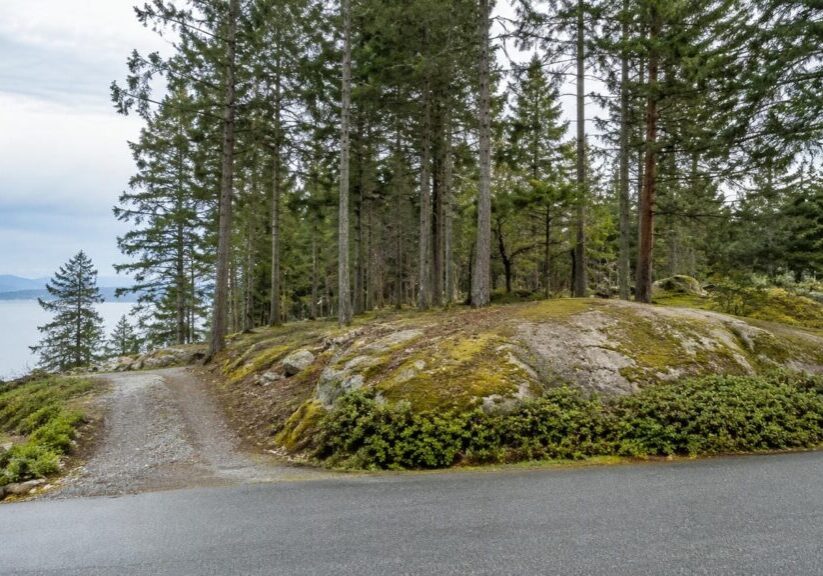
In Nanaimo you can take out up to four ordinary trees from your own property in a calendar year without a permit. The word doing the work there is “ordinary”. The allowance never reaches a protected tree or a significant tree, and it disappears the moment you apply to subdivide or for a development permit. So whether your Nanaimo lot needs a tree removal permit turns less on how many trees you want gone than on which trees they are and how far along your project already is. What follows from there is worth knowing before you spend anything: replacement planting is where the money goes, a dead tree and a dangerous tree take two different routes, and the calendar decides when a crew can start. Tree decisions also shape the house, which is why a custom home builder Nanaimo owners hire early raises them before the design is drawn rather than after.
The Short Answer: Four Ordinary Trees a Year, Until You Apply for a Development Permit
Three conditions have to hold at once before that allowance is yours to use. The tree cannot be a protected tree. It cannot be a significant tree. And no subdivision or development permit application can already be in. All three come from the City’s tree bylaw, formally the Management and Protection of Trees Bylaw 2013 No. 7126, and if any one of them fails, the count stops meaning anything.
What the Bylaw Counts as a Tree
Most owners assume the small stuff does not count. The bylaw does not work on feel, it works on a tape measure. A tree, for its purposes, is a living woody plant whose stem is 6 cm or more across at chest height, about 1.4 m off the ground, and that is capable of reaching a mature height of 4.5 m or more. That sweeps in a great deal of what a homeowner would call scrub. The 10-year-old alder along the back fence is a tree. So is the volunteer maple you have been meaning to deal with. Measure before you assume anything about your numbers. Four is a count of trees by that definition, not by eye.
“Ordinary” Is a Narrower Category Than It Sounds
Most pages on this topic tell you the allowance covers four trees as long as none of them are significant. That is not what the bylaw says, and the difference matters on a treed lot. The allowance only ever applied to ordinary trees, and the protected class is wider than most owners picture. It takes in City trees, significant trees, every tree standing inside a development permit area, trees in areas covenanted to hold a slope or provide a landscape buffer, trees an approved development permit landscape plan designated for retention, and trees with scientific value. So counting to four is the second step, not the first. The first step is finding out whether the trees in front of you are in the protected class at all. On some lots very few of them are available to count.
The Development Permit Clause That Closes the Allowance
The allowance is void once an application for a subdivision or other development permit has been made. It says nothing about a building permit, which is worth holding onto, but it catches most custom builds anyway. A treed, sloped or waterfront lot in Nanaimo usually needs a development permit before anything else happens, so the practical rule is short: once your application is filed, stop counting trees and start applying for them. If your build genuinely needs nothing but a building permit, that is worth confirming with the City in writing before a saw comes out. A verbal answer at a counter is not something you can produce later.
When Nanaimo Requires a Tree Removal Permit
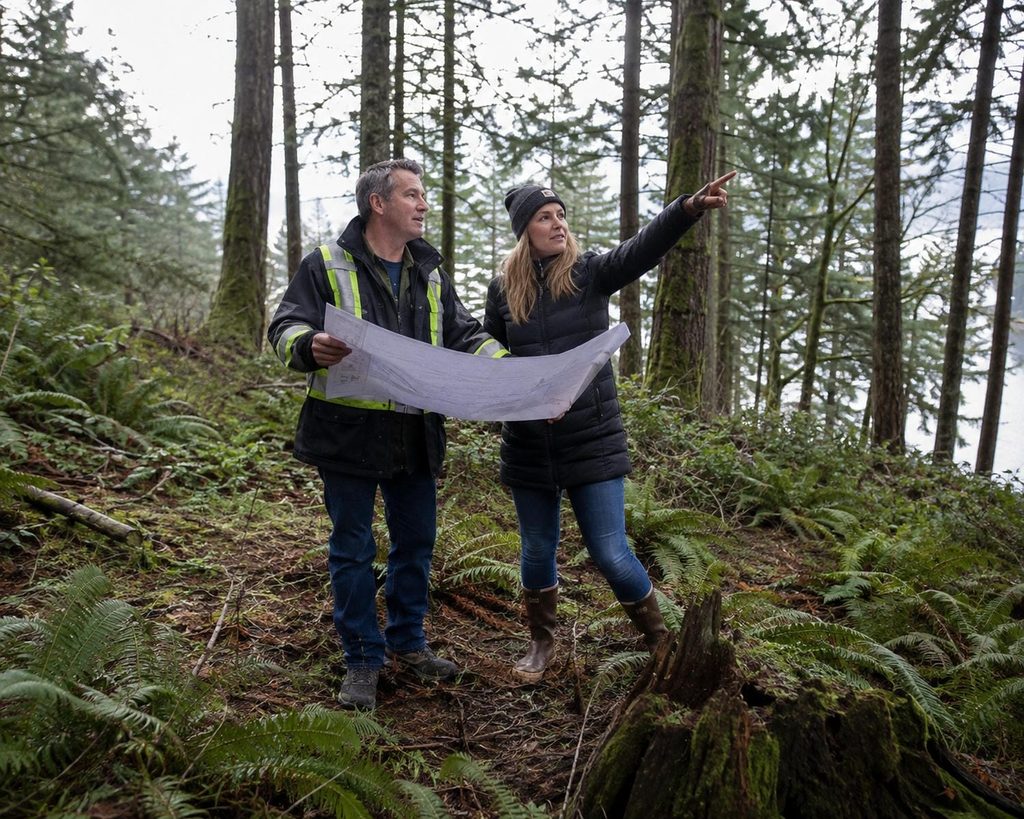
Reading the rules as a list of exemptions is the wrong way round for anyone building a house. Almost every custom build lands inside at least one of the City’s positive triggers, usually more than one, and the tree removal permit then sits alongside the other permits your build will need rather than off to one side of them. Each trigger has a different consequence for your schedule.
| What triggers the permit | What that looks like on a real lot | What it means for you |
| Tree removal for a proposed development | Trees stand in the way of the house footprint, the driveway or the service trench | Apply before any cutting, and show the trees on the same drawing as the house |
| Tree removal for the subdivision of a parcel | You are splitting the parcel, or buying a lot out of a fresh subdivision | Find out what retention was already committed at the subdivision stage |
| More than four ordinary trees of 6 cm or larger in a calendar year | Any clearing job of real size on a treed lot | Count by the bylaw’s definition, and apply once you pass four |
| Logging commercial timber | A larger rural parcel where the standing wood has value | Its own activity, with its own plan requirements on top |
| Cutting or pruning a significant tree | A Garry oak near the driveway, or a listed heritage or wildlife tree | Get written approval first, and note that pruning counts here, not just felling |
| Tree removal in a watercourse setback or other development permit area | A creek at the back, an unstable bank, a wildfire or sensitive area designation | Every tree inside the designated area is protected, so the four-tree allowance does not reach it |
What Counts as Cutting, and What Counts as Maintenance
The permit requirement is not limited to felling. Cutting, pruning, damaging or otherwise affecting a protected tree needs the City’s approval first, and the bylaw names the acts it means: damaging roots inside the drip line, operating equipment over the root zone, stripping bark, constructing inside the drip line, and removing soil. On a build site that list describes a normal Tuesday for an operator who was never told which tree matters.
The other half of the question is whether you can still prune anything. You can. Ordinary care and maintenance pruning carried out to standard arboricultural practices is exempt, and so is an owner pruning or removing an existing hedge on their own parcel. Both of those sit behind the same gate as every other exemption in the bylaw, so neither reaches a protected tree. Pruning a significant tree, a City tree, or any tree standing inside a development permit area still needs the City’s written approval before you start. Ordinary yard work on ordinary trees is not what this bylaw is aimed at. Work that changes a protected tree’s future is.
Which Trees Are Protected, and Why Size Intuition Fails
Two categories run through everything here, and readers mix them up constantly. A significant tree is a listed class: heritage, wildlife and landmark trees. A protected tree is the wider category, and it is the one that decides whether the four-tree allowance reaches a tree at all. Every significant tree is protected. Not every protected tree is significant.
Heritage, Wildlife and Landmark Trees
“Significant tree” is a defined class, not an officer’s opinion formed on a site visit. It breaks into three groups. Heritage trees are listed individually for their historic or cultural value. Landmark trees are listed species standing above a listed minimum size. Wildlife trees are trees protected as habitat for a nest or an egg under provincial wildlife law, and that one is worth landing precisely, because it is the same body of law behind the nesting-season problem later in your build calendar. On a Nanaimo lot an active nest does not simply make the timing awkward. It can move the tree itself into the protected class.
The Size That Matters Depends on the Species
Here is the fact that overturns most people’s assumptions. The minimum size that makes a tree protected is set per species, and the range is wide, running from 10 cm at the low end to 80 cm at the high end. A Douglas fir is only protected once it reaches 80 cm across at chest height. A Garry oak is protected at 10 cm. So the biggest tree on your lot can be entirely ordinary while a slender one beside the driveway is untouchable. The City has singled out Garry oak, arbutus, Pacific dogwood and western yew as species of particular concern, and it publishes the full species list with each one’s critical size in the bylaw. Identify what you have and measure it before you plan anything around it.
Where the Tree Stands Can Protect It on Its Own
Location protects trees that species and size never would, and this is the category that catches custom-home buyers. A tree is protected because of where it stands when it is a City tree, when it stands inside a development permit area, when it sits in an area covenanted to hold a slope or provide a landscape buffer, or when an approved development permit landscape plan designated it for retention. None of that is visible from the driveway, and none of it depends on the species or the size. The consequence is worth stating plainly: for those trees the species question never gets asked, because the location has already answered it.
The Tree on the Boulevard Is Not Yours to Remove
This comes up on almost every build, because a new driveway usually has to cross the boulevard to reach the road. City trees are protected trees under the bylaw’s own definition, so the exemption list never reaches them, and the four-tree allowance is irrelevant to them. Beyond that, removing trees from City land is prohibited outright, and going onto public property to prune or remove without the City’s consent is an offence in its own right. The boulevard tree belongs in the driveway conversation you have with the City at design stage. It does not belong in the conversation you have with a clearing crew on the morning they arrive.
Development Permit Areas: Where Every Tree Is Protected
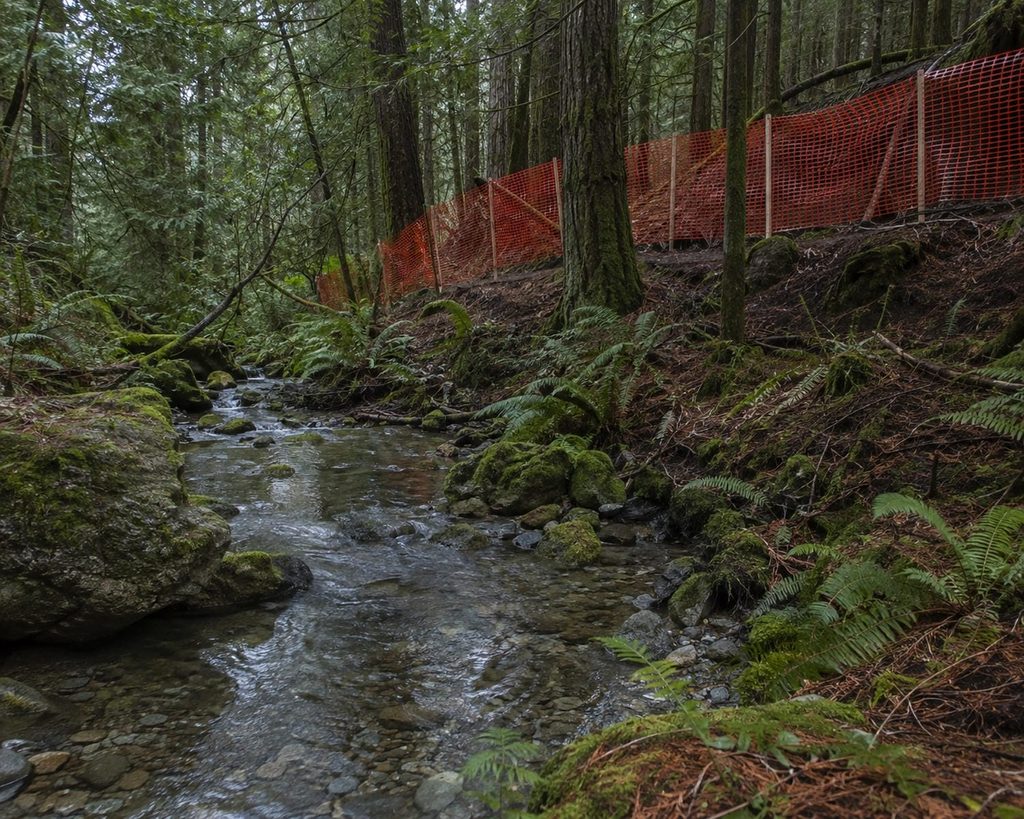
A development permit area is not an outside authority overruling the tree bylaw. It is a City designation, and the tree bylaw reaches out and adopts it: a tree standing inside a designated area is a protected tree by definition, whatever its species or size. These designations follow watercourses, slopes and habitat rather than property lines, so a designation often covers only part of a parcel. Find where the line runs across your lot. Trees inside it and trees outside it are in completely different positions. Four kinds of designated area matter most to a house build.
Environmentally Sensitive Areas: The Permit Comes Before Any Clearing
In an environmentally sensitive area, a development permit is required before any proposed development, and development here reaches clearing rather than being limited to building. The application asks for a detailed biophysical assessment of the property prepared by a qualified registered professional, and permanent fencing has to be installed to protect the sensitive area before construction begins. The practical reading for an owner is that inside these areas the clearing question is settled by a professional’s assessment as part of the permit, not by you counting trees on a Saturday morning.
Hazardous Slopes: Vegetation Removal Is Named in the Rule
Most rules of this kind talk about buildings and excavation and leave vegetation to be inferred. This one names it directly: no vegetation removal, no significant excavation and no placement of fill in areas subject to bank instability, with a permit required before any development and a geotechnical engineer’s report forming part of the application. Keep that pointed at the trees, because that is where it bites first. A treed slope reads to an owner as the easiest part of the lot to tidy up. It is usually the part that is locked hardest, because the vegetation is doing structural work.
Wildfire Areas Want a Tree Survey
In the wildfire hazard area, a development permit is required before a residential building goes up or land is subdivided, and the application asks for a detailed tree survey along with a report from a professional experienced in wildfire interface protection. That is a meaningful ask for a single-family house, and it surprises people. Wildfire interface planning and canopy retention pull in opposite directions on the same lot: one wants fuel reduced and separation around the structure, the other wants mature trees kept. Those two goals cannot both be maximized on a small treed parcel, which is exactly why the City asks for the survey rather than leaving the judgement to the owner.
Creeks, Wetlands and the Riparian Assessment Area
Two layers apply near water, and both reach clearing rather than just building. Municipally, no development or alteration of land is permitted within a leave strip or watercourse, and no building, driveway, patio or other hard surface can sit inside one. Widths are set individually for named watercourses, with 15 m inland from the boundary for ponds, lakes, wetlands and the sea. Provincially, the riparian assessment area runs 30 m from the high water mark on both sides of a stream, and work inside it needs an assessment report from a qualified environmental professional. The two systems are wired together rather than running in parallel: the tree bylaw’s own exemption list names riparian assessment areas directly. Clearing counts as development in both, so a creek at the back of the lot changes the plan before a saw is started, and it is worth settling that alongside the rules for building near water on Vancouver Island.
How to Find Out Which Areas Your Lot Sits In
You can answer this in a week. Check the City’s mapping for development permit area designations against your address, and note where the boundary crosses the property rather than just whether it touches it. Pull the title and read it for covenants tied to slope stability or landscape buffers, because those bind you and nothing on site announces them. Look for a watercourse on or beside the land, and remember that mapped watercourses carry their own individually scheduled widths. Then find out whether the lot came out of a subdivision with a retention plan attached to it. Do all of that before you commission a design. Every one of those answers is an input to where the house goes.
Dead, Diseased and Hazardous Trees: Two Different Routes
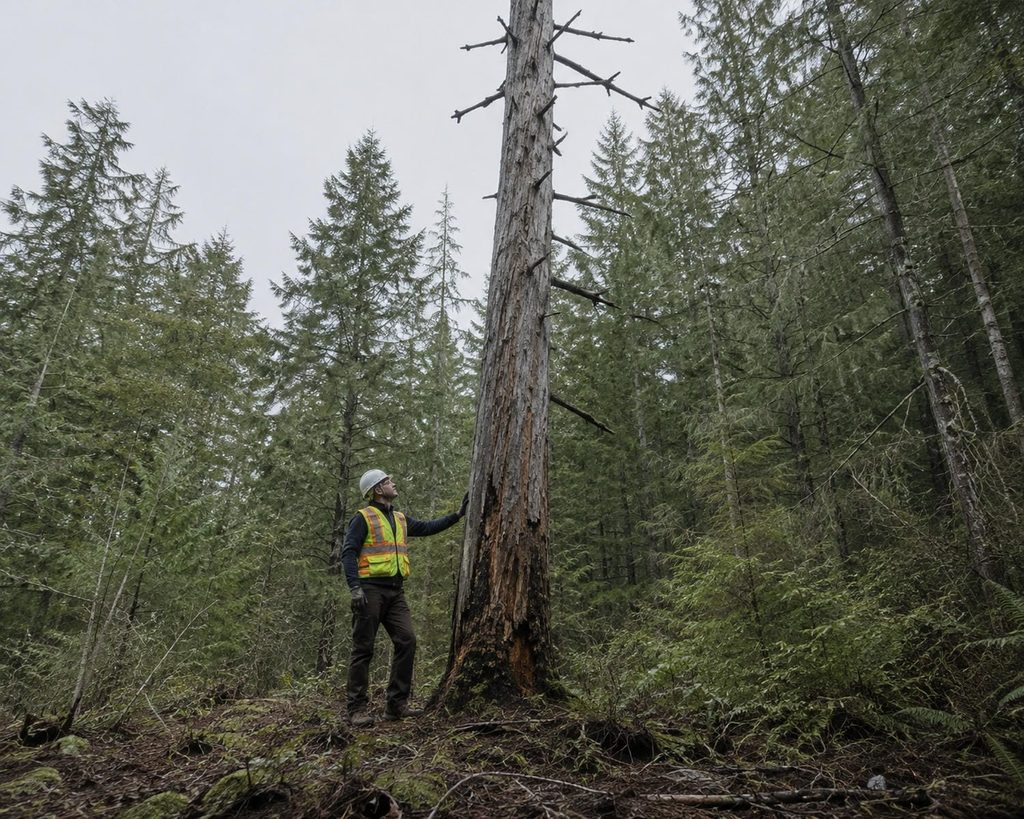
This is the most common follow-up question on the whole topic, and the answer splits in two straight away. A tree that is genuinely dead and a tree that is alive but dangerous are handled completely differently under the bylaw, and the difference is not obvious from the outside.
The dead tree is the simple case. The bylaw exempts a dead tree outright. There is no arborist determination attached to the clause, no application to submit and therefore nothing to pay. Two cautions ride with that. It sits behind the same gate as every other exemption, so it does not reach a tree the City already protects for another reason, such as one standing inside a development permit area or one covered by a covenant on your title. And once the tree is on the ground, nobody can check that it was dead.
A tree that is still alive but diseased, damaged or hazardous runs a different route, and the order of it is the whole answer. A Certified Landscape Horticulturist or Certified Arborist determines the condition, not the owner and not the faller. Written approval from the City comes next, before any cutting or pruning happens. The work is then carried out to standard arboricultural practices. And replacement planting attaches only where the tree removed was a significant one, which is the opposite of what most readers assume when they hear the word hazardous.
Two things about that route are worth stating plainly. It is technically an exemption rather than a permit, but it still needs the City’s written sign-off in advance, so it is not a self-serve option. And it is the one scenario where the arborist question has a definite answer: yes, and their determination comes first.
The failure mode here is predictable and almost always the same. The route exists, but it has to be walked before the tree is on the ground rather than after. So photograph the tree standing, from several angles. Get the condition in writing from a certified professional if there is any doubt at all. And if the tree stands near a creek, a slope or a mapped sensitive area, phone the City before the saw comes out. There is a related decision worth making early rather than late: a big conifer that will be left exposed beside a new house is a windthrow question, and the time to settle it is at design stage, while the siting can still move, rather than the first winter after occupancy when the only options left are expensive ones.
What the Permit Costs and What You Have to Submit
The application fees are capped. Whatever the build looks like, they stop at $2,500. What the permit obliges you to do afterwards carries no cap, because replacement counts scale with the size of what comes down and the security is calculated from the value of the trees involved.
What the Application Fees Come To
The City’s current application carries a $50 application fee, a cutting fee calculated as $10 per tree or $500 per hectare of cutting area, and $100 for each significant tree, all to a maximum total of $2,500. Confirm the current figures on the form when you apply, because fee schedules get revised and the form is where the change shows up first. One sequencing point: removing trees first and applying afterwards costs more in fees than doing it in the right order, on top of everything else that follows an enforcement file. Working backwards is the most expensive way to run this.
What Goes in the Application
The City asks for a site plan with the tree locations mapped, a description of the site covering topography, soils, water features and vegetation, a tree-by-tree removal and retention proposal with measurements, maps marking what comes down, what stays and which trees are significant, and the replacement planting identified by species, number and size with a map of where it goes. For a straightforward removal, nothing on that list requires an arborist by name. Where you will definitely need one is on the diseased or hazardous route, and where your lot sits in a sensitive, wildfire or slope area and the City wants a qualified professional’s assessment. Ask the City which of those applies to your lot before you pay for a report you may not need.
The Tree Management Plan Goes In With Your Application
The owner provides a tree management plan with the application, showing the species, size and locations of the trees to be removed and the trees to be retained. Subdivisions, commercial timber on larger parcels and cutting done contrary to the bylaw each add further plan requirements on top of that baseline. What makes the plan more than a formality is what it has to show. Watercourses and their setbacks, ravines, steep slopes and sensitive areas go on it, and so do the proposed road layout, the service locations and the building locations, all drawn against the removal and retention areas. The City is asking for the house and the trees on one drawing. The tree decision and the siting decision are the same decision.
If the City Says No
A City director issues or refuses the permit, and a refusal is not the end of the road. The owner has a right to have Council reconsider the matter. The request goes in writing to the City’s corporate officer, a separate appeals bylaw governs how it runs, and the window is short and starts from when the decision reaches you, not from when you decide to challenge it. So ask for the deadline on the day the decision arrives rather than looking it up a week later.
What You Owe After the Trees Come Down: Replanting, Deposits and Security
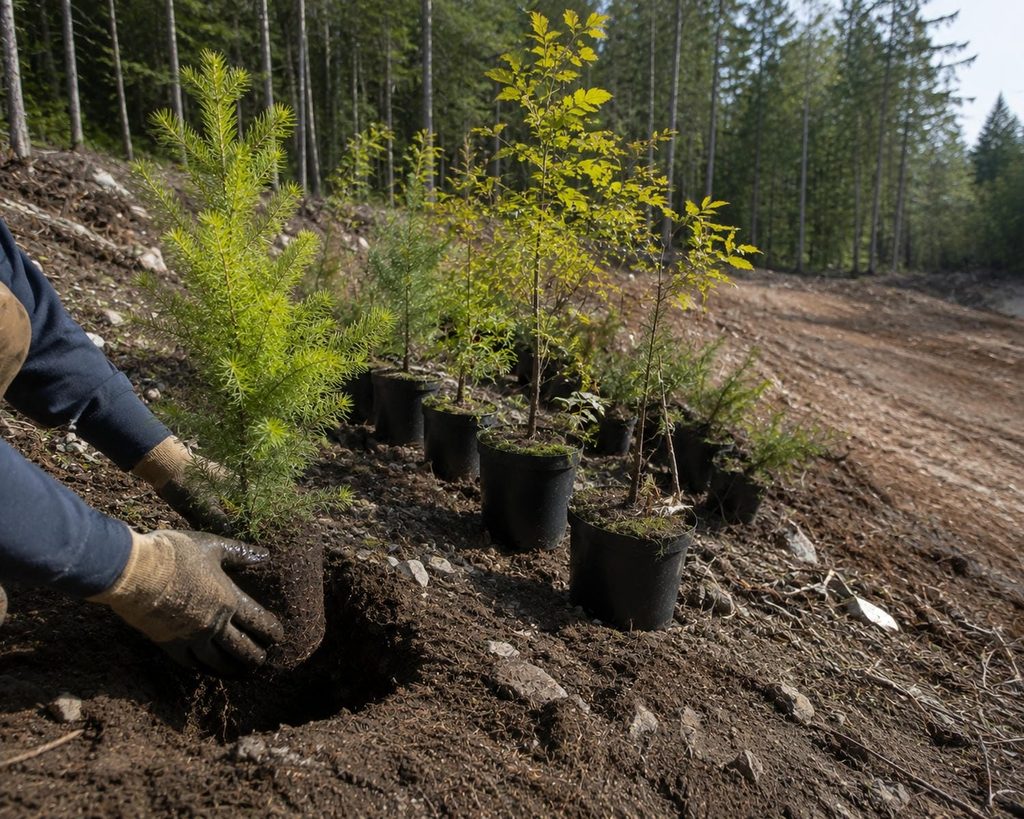
The bylaw’s requirements do not end when the permit is issued. Trees have to go into the ground to a specification, and money stays with the City until both the planting and its survival have been verified. That second half runs for years after the crew has gone.
What You Have to Plant Back, and What Qualifies
First the count. Replacement planting scales with what you take out: a small tree is replaced by a couple, and the largest can require up to eight replacements each. Protected trees carry their own ratios depending on where they stand, and those rise near watercourses, on steep slopes and in character protection areas. Get your own count confirmed by the City when you apply, because that ratio is what turns a capped permit fee into an open-ended obligation.
Then the specification, which is concrete and easy to get wrong at the garden centre. A replacement has to be over 1.5 m tall when planted, coniferous or deciduous, and capable of growing past 4.5 m at maturity. Fruit trees qualify. Shrubs, dwarf trees, anything planted as a hedge, and species commonly used as hedging do not, which rules out much of what people choose for a new yard. And the consequence almost nobody knows in advance: once those replacements are in the ground they are protected trees themselves, and taking one out later needs a permit. You are not planting decoration. You are planting the next generation of regulated trees on your own lot.
The $300 Deposit
Small, specific, and easy to miss until it turns up on a statement. The City holds a $300 deposit to make sure trees actually get planted, either with a building permit or as replacement trees under a tree removal permit. How many of those apply depends on how many trees you are replacing, so confirm the count with the City for your specific build rather than assuming one. This is the clearest evidence that Nanaimo’s tree rules reach into the building permit itself, not only into a separate tree file that closes when the clearing is done.
The Security Deposit Applies Whenever Replacement or Retention Is a Condition
Where replacement trees or retained trees are required as a condition, the owner shall provide the City with a security deposit. There is no size threshold, no minimum tree count, no discretion and no exemption. It also reaches people who never held a permit at all, because it applies as a consequence of cutting or removing trees without one. The amount is 120 percent of the value of all the replacement and retained trees, plus site restoration and cleanup, and it can be posted as cash or as an automatically renewable letter of credit. Half of it is held through the first year after the planting goes in, and a further 10 percent through the second, so the money is tied up across two growing seasons rather than until the trees are planted. And the security is not a formality. If the owner does not comply with the permit’s terms, the City can enter the property and do the work itself.
Budgeting for a Treed Lot
The permit fee has a ceiling and the rest of it does not, so the number that matters is not the fee. It is the count of trees coming down and what each one obliges you to plant back. Budget for four things rather than one: the felling and hauling, the professional reports the City may ask for, the permit itself, and the replacement planting plus the security held across two growing seasons. Moving the house 3 m on a plan is a drafting afternoon. Moving it after the excavation is open is not. This is exactly the kind of obligation that turns into a budget surprise late in a build, which is why we price a treed lot’s tree work into the fixed-price contract at the front end instead of leaving it as an allowance that drifts.
When You Can Actually Do the Work
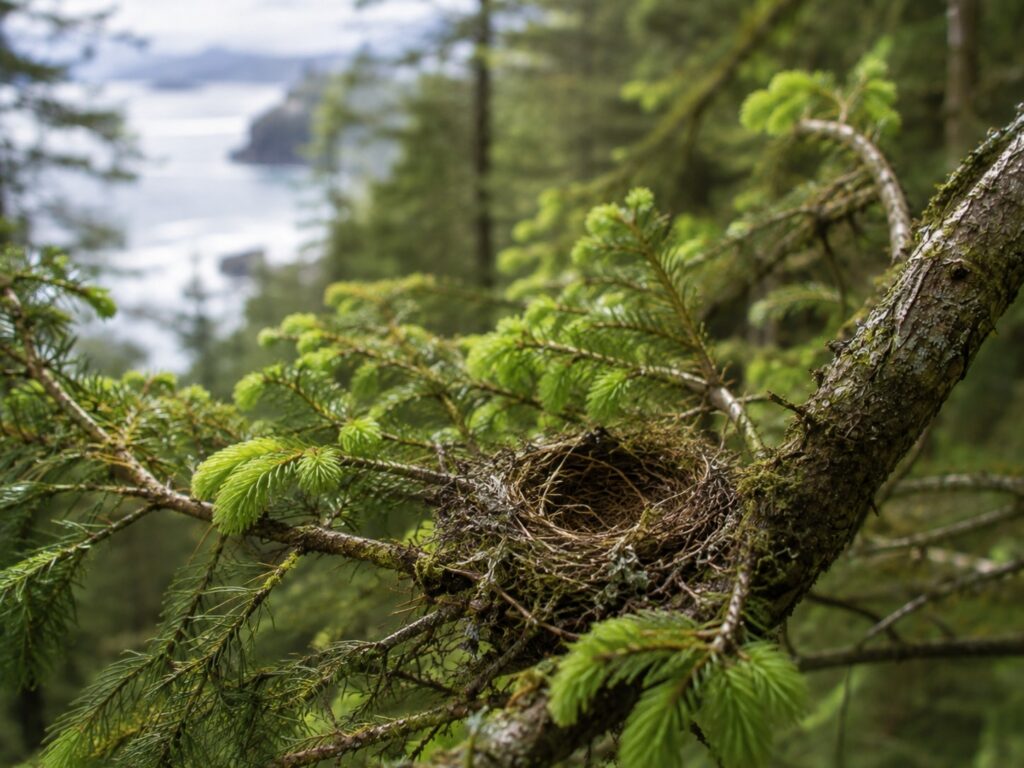
Three separate constraints decide when a crew can start. One runs on the calendar, one runs on the weather, and one runs on the City’s queue. Between them they can cost you a build season, and none of them cares that your excavator is booked.
Nesting Season Runs Roughly Late March Through Mid August
This is the constraint most likely to cost real time. Nesting season on the coast runs from roughly late March through mid August, and it peaks through May, June and July. Inside that window you cannot simply clear. Either the trees come down before it opens, or a qualified professional surveys for active nests first and you leave a buffer around anything found. The nests of certain birds, including eagles and herons, are protected whether or not they are occupied at the time. And because the bylaw’s own definition of a significant tree takes in trees protected as nest habitat, an active nest in Nanaimo can make the tree itself protected rather than merely making the timing inconvenient. Losing that argument in April usually means losing the season.
Winter Ground Is a Practical Limit, Not a Legal One
No rule stops you clearing in February. Island winters make it a poor plan anyway. Saturated ground ruts and compacts under machine traffic, sediment runs where you do not want it, and you can hand yourself a subgrade problem on the exact footprint you are about to build on. A churned building envelope in January is a remediation cost in June. We plan machine work around drier ground rather than around the calendar, and on a treed lot that judgement gets squeezed from both ends: the nesting window closes off the late spring and summer, and the wet season closes off much of the winter. That leaves a narrower working period than most people assume.
Apply Before You Book the Crew
Put the application in as early as your site plan allows, because the site plan is the real gate on the paperwork and it is under your control. Treat approval timing as something you schedule around rather than a date you can promise anyone. And never book a clearing crew against an approval you do not yet hold, because the crew will be paid either way and the tree will not care. Inside a real build schedule this is a handful of dates. We put the permit dates on the schedule alongside the trades, which is what keeps a missed nesting window from turning into a six-month hole.
What Happens If You Clear First and Ask Later
Clearing without the permit you needed is not a paperwork problem, and the consequences stack rather than substituting for one another. The bylaw allows fines of up to $50,000 plus the costs of prosecution, and every day of the violation counts as a separate offence. On top of that, someone who cuts a tree contrary to the bylaw has to produce a tree management plan after the fact, for work that is already done. Replacement planting follows from that plan. And the security requirement reaches unpermitted cutting explicitly, so a deposit gets posted against replanting nobody budgeted for. Fees run higher working backwards than forwards as well.
Then the part a builder sees happen. An enforcement file lands at the precise moment you most need the City’s cooperation on everything else: the building permit, the servicing, the inspections, the schedule you have already committed to trades. None of those get easier while an open file has your address on it. The simplest fix on this entire subject is asking first, and it usually costs a phone call.
Subdivided Lots Arrive With Tree Decisions Already Made
If you are buying a newly created lot, do not assume a blank sheet. Where a parcel being subdivided is larger than 0.5 ha, roughly an acre, the subdivider has to protect at least 20 percent of the trees on it, not counting any area set aside for park dedication. Subdividers also have to protect or replace protected trees, and plant a tree on each new single-family or duplex lot after occupancy. So some of the trees on a new lot are already somebody’s commitment.
The same is true of trees designated for retention in an approved development permit landscape plan, and of trees in areas covenanted for slope stability or as a landscape buffer. Both of those bind the new owner. Neither is visible from the driveway, and neither will be mentioned by anyone during a viewing. Two documents answer this quickly. The title tells you about covenants. The approved subdivision or development permit tells you about retention designations. Both belong in due diligence, before you own the problem, which is the same stage as the rest of choosing a custom home lot in Nanaimo and not a design-stage question at all.
If Your Lot Sits Outside Nanaimo’s City Limits
If your land is in Ladysmith, out toward Parksville, or in the rural areas around Nanaimo, the Regional District of Nanaimo is your authority rather than the City. The Regional District protects trees through development permit areas, its regional growth strategy, zoning and conservation covenants, and its environmental development permit areas commonly prohibit site disturbance until a permit has been approved. The designations that catch tree cutting include freshwater and fish habitat, sensitive ecosystems, aquifers, marine coast, hazard lands, and a dedicated area for eagle and heron nesting trees. In the sensitive ecosystems area, removing vegetation is itself a trigger, so clearing is the regulated act and not merely a step toward one. Land under the provincial managed forest land regime is treated differently again. Two things are worth doing early: check the Regional District’s zoning map for your lot’s status, and read the state of title certificate for covenants that limit vegetation removal.
How Tree Retention Shapes the House You Can Build
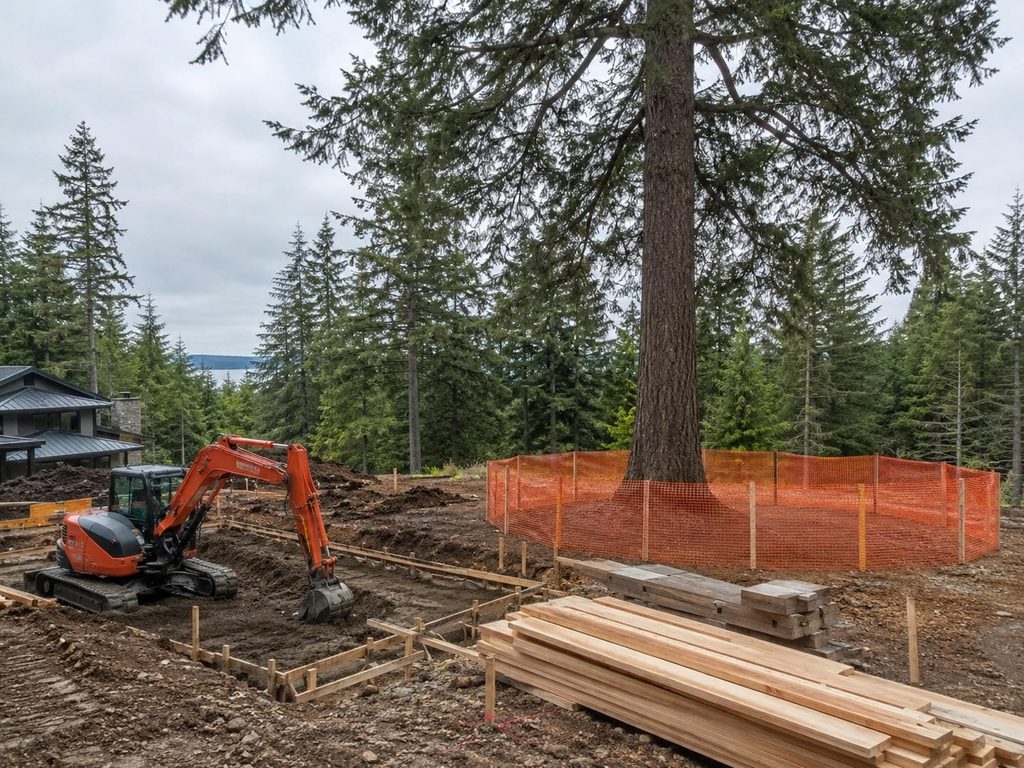
Every tree you keep is a constraint on the build, and the constraint is always bigger than the tree. This part never appears in a bylaw summary, because it is not a rule. It is what happens when the rules meet an excavator, a foundation and a delivery truck.
The Root Zone Is a No-Go Zone
A retained tree carries a protected zone roughly matching its canopy spread, and inside that zone the bylaw’s prohibited acts read like a description of ordinary site work: driving equipment over the roots, excavating, stripping or adding soil, and building. That zone competes directly with the excavator’s working room, the foundation footprint, the perimeter drain and the service trenching. Grade change inside the root zone is the most common reason a retained tree dies two summers after occupancy. One practical correction, because it gets done wrong constantly: the protective fencing goes around the root zone, not around the trunk.
Access and Driveway Alignment Usually Decide Which Trees Go
Owners choose the tree they dislike. The site chooses the tree that is in the way. The driveway alignment, the crane or excavator approach, and the material laydown area between them determine which trees are genuinely removable and which ones you were always going to lose. Settle that before the design is fixed and the tree budget and the siting stop fighting each other. On Vancouver Island the specifics bite: narrow treed frontages, a single feasible approach off the road, and no room to stage lumber except the one flat spot under the best tree. Discovering that after the drawings are approved costs a redesign or a tree you meant to keep.
If the Driveway Has to Cross a Creek, Start That Clock Early
If your driveway has to cross a creek, that culvert or bridge is its own provincial process, entirely separate from anything the City asks about trees. Work of that kind has to be notified to the Province at least 45 days before it starts, and the work itself is restricted to certain times of year on top of the notification. That combination makes it the single item most likely to move your start date. Identify it at the point the driveway alignment is drawn, not when the machines are booked, because 45 days from the day you notice is a very different date than 45 days from the day you drew the line.
Not Every Tree Is Worth Keeping
None of this is an argument for saving everything. A conifer that spent forty years inside a closed stand grew tall and thin because its neighbours sheltered it. Take those neighbours away and it is alone in an open yard with a root plate never built for wind. That is a windthrow candidate. Retaining the wrong tree beside a new house is worse than removing it, because it becomes a hazard the owner now owns, standing over the roof they just paid for. So ask four questions about any candidate tree: how did it grow up, what is being removed around it, how close will the excavation edge come, and will it still be a good tree in ten years. If the answers are poor, include it in the permit application and plant something that will thrive in the yard you are creating.
Building on a Treed Nanaimo Lot
Tree work is one of several lot conditions that get decided before a design is fixed, alongside the soils, the slope, the servicing and the setbacks. The builds that run smoothly are the ones where that sequencing was deliberate rather than discovered. Southpaw Homes is a BC Housing Licensed Residential Builder, and we plan design-build custom homes on a detailed build schedule that carries the permit lead times and the nesting window as real dates rather than assumptions, with permit status and site progress visible to you daily in the client portal. If you are weighing a treed lot in Nanaimo, or you already own one and want to know what you can and cannot touch before you commission a design, get in touch or book a consultation and we will walk the property with you.
Frequently Asked Questions
Can I Cut Down Trees on My Own Property in Nanaimo Without a Permit?
Up to four ordinary trees per calendar year, on your own parcel, provided none of them are protected trees or significant trees and no subdivision or development permit application has been made. All three of those conditions have to hold at the same time. The protected class is the one that catches people, because it includes every tree standing inside a development permit area and every tree in an area covenanted for slope stability or as a landscape buffer, regardless of species or size. So check whether any of your trees are protected before you count to four.
Do I Need a Permit to Remove a Dead Tree in Nanaimo?
No. The bylaw exempts a dead tree outright, with no application and no arborist determination attached to the clause. The exemption sits behind the same gate as every other one, so it does not reach a tree the City already protects for another reason, such as one inside a development permit area or one covered by a covenant on your title. Document the condition before it comes down, because once the tree is on the ground there is no way to show anyone that it was dead.
How Much Does a Tree Removal Permit Cost in Nanaimo?
The City’s current application carries a $50 application fee, a cutting fee of $10 per tree or $500 per hectare of cutting area, and $100 for each significant tree, capped at a total of $2,500. Confirm the current figures on the form, since fee schedules change. The shape worth understanding is that the fees have a ceiling and the obligations that follow them do not: replacement counts scale with the size of what comes down, and the security deposit runs at 120 percent of the value of the replacement and retained trees plus restoration and cleanup.
What Makes a Tree a “Significant Tree” in Nanaimo?
Significant trees fall into three groups: heritage trees listed individually for their historic or cultural value, wildlife trees protected as habitat for a nest or an egg under provincial wildlife law, and landmark trees, which are listed species standing above a listed minimum size. That minimum is set per species and the range runs from 10 cm to 80 cm across at chest height. A Douglas fir is only protected at 80 cm. A Garry oak is protected at 10 cm. The City publishes the full species list with each one’s critical size in the tree bylaw.
Do I Need an Arborist to Remove a Tree in Nanaimo?
Not for a straightforward removal. The application asks for a site plan, a site description, a removal and retention proposal and a tree management plan, and nothing on that list requires an arborist by name. You will definitely need one where you are claiming a tree is diseased, damaged or hazardous, because a Certified Landscape Horticulturist or Certified Arborist has to make that determination before the City will approve anything. You will also need a qualified professional’s assessment in a sensitive, wildfire or slope area. Ask the City which applies before you pay for a report.
Can I Clear My Lot in the Summer?
Not simply, because nesting season on the coast runs from roughly late March through mid August and peaks through May, June and July. Inside that window you have two options: bring the trees down before it opens, or have a qualified professional survey for active nests first and leave a buffer around anything found. An active nest in Nanaimo can also move the tree itself into the protected class, so this is not only a timing question. Plan clearing around the window from the start, because discovering it in April usually costs the whole season.
What Happens If Trees Were Removed Without a Permit?
The consequences stack rather than replacing one another. The bylaw allows fines of up to $50,000 plus the costs of prosecution, with every day of the violation counting as a separate offence. On top of that, anyone who cuts a tree contrary to the bylaw has to produce a tree management plan after the fact, replacement planting follows from it, and the security deposit requirement reaches unpermitted cutting explicitly. Fees also run higher working backwards than forwards. If it has already happened, go to the City yourself rather than waiting for the file to find you.
Can I Remove the Boulevard Tree in Front of My Lot to Put In a Driveway?
No. A City tree is a protected tree under the bylaw’s own definition, so no exemption reaches it, and removing trees from City land is prohibited outright. Going onto public property to prune or remove without the City’s consent is an offence on its own. What you do instead is raise the driveway crossing with the City at design stage, while the crossing location is still movable and the alignment can be drawn around the tree. That conversation is easy at the drawing stage and impossible on the morning the crew arrives.